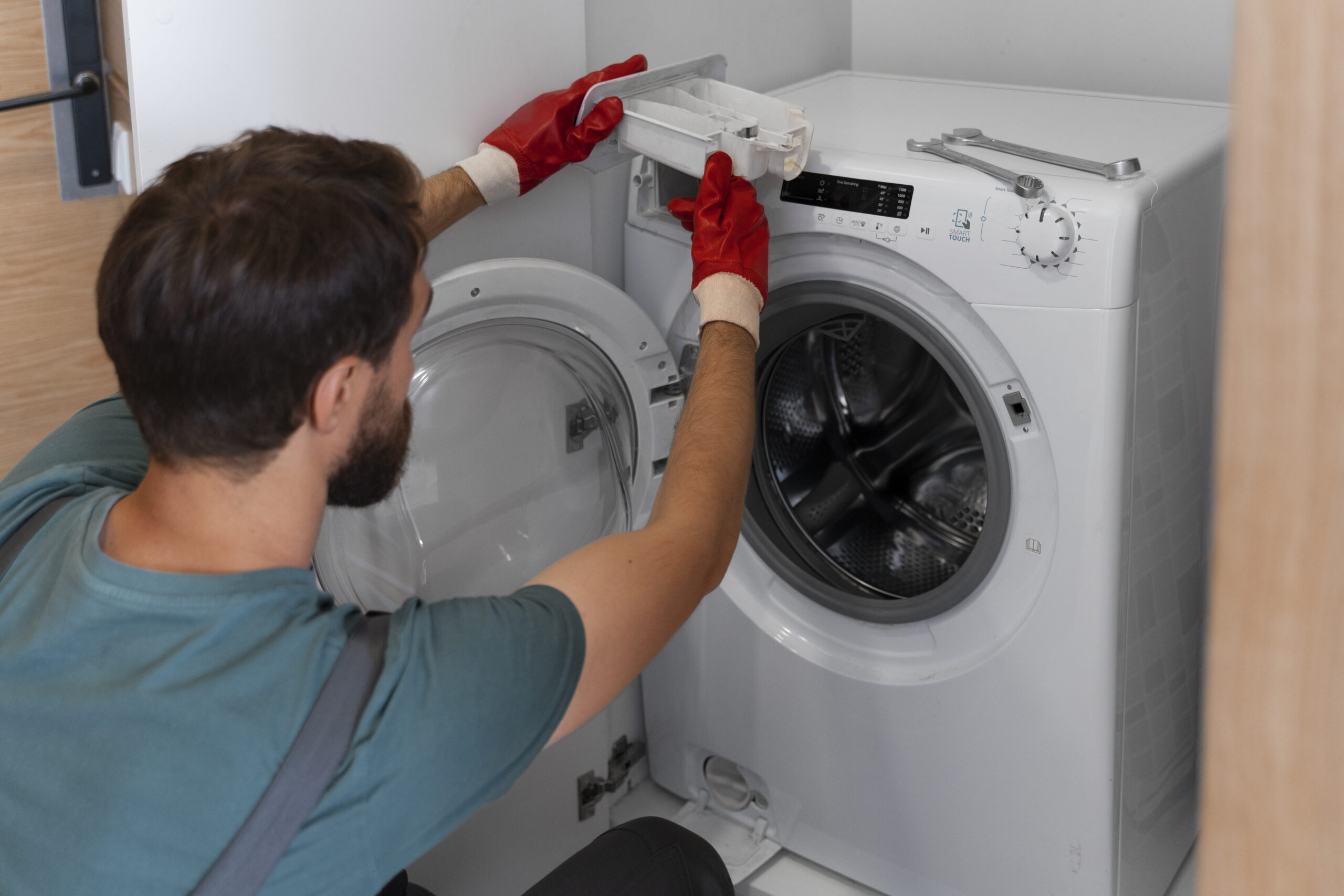
Most washing machine problems come down to a short list of usual suspects: a clogged pump filter, an unbalanced load, a worn door seal, or a drain hose that’s kinked somewhere you can’t quite see. This guide sorts common failures by symptom, so you can jump straight to the section that matches what your machine is actually doing instead of working through a generic checklist.
Every symptom page below ranks causes by how often they turn out to be the real problem, includes at least one test you can run before buying any parts, and tells you plainly when a fix is a five-minute adjustment versus when it’s time to call a professional. Where a fix genuinely varies by manufacturer or by top-load versus front-load design, we say so instead of pretending one procedure covers every machine.
Washing Machine Won’t Drain
Water sitting in the drum at the end of a cycle is one of the most common washing machine complaints, and it’s usually a clogged pump filter or a blocked drain hose rather than a failed motor. Start with Washing Machine Not Draining: Causes Ranked by Likelihood for the full diagnostic order before assuming you need a replacement part. Brand-specific guides are also available for Whirlpool, GE, Samsung, and LG machines.
Washing Machine Not Spinning
A machine that fills and washes but won’t spin at the end of the cycle usually hasn’t finished draining, hasn’t confirmed the door is locked, or has a worn drive component that’s no longer transferring power to the drum. See Washing Machine Not Spinning: Causes Ranked by Likelihood for the full breakdown, including the door lock and motor coupling checks most people skip, and what it means if the machine gets stuck partway through the spin cycle instead of never starting.
Washing Machine Smells Bad
A musty or sour smell is almost never a sign of a broken part. It’s detergent residue and trapped moisture somewhere air doesn’t reach, usually the door gasket fold on front-loaders or the dispenser drawer on any machine. It’s also one of the few problems you can usually solve for free. Details: Washing Machine Smells: Where the Odor Is Actually Coming From. For the full deep-clean protocol, see our front-load washer cleaning guide.
Washing Machine Leaking
Water on the floor around or under a washing machine is urgent, both because it’s a slip hazard and because it sits close to a running electrical appliance. Where the water appears (at the door, underneath the unit, or only during fill or spin) narrows the cause considerably before you open anything. Full walkthrough: Washing Machine Leaking: Find the Source Before You Call a Pro.
Washing Machine Shaking, Walking, or Banging
Excessive vibration, a machine that “walks” across the floor during spin, or loud banging is most often an unbalanced load or a machine that isn’t sitting level, not a mechanical failure. It’s also one of the fastest problems to rule out yourself. Full guide: Washing Machine Shaking or Vibrating: Fix an Unbalanced Load.
LG washers have their own documented error codes: OE (drain), UE (unbalanced load), IE (water inlet), LE (motor locked), dE (door won’t lock), and FE (overfill), plus a general LG reset guide. Whirlpool error codes are covered on their own reset guide. Samsung washers have SUD (excess suds), 4E (not filling), UE (unbalanced load), DE (door error), OE (overflow), 5C (no drain), and LE (water level or leak), plus their own reset guide. Bosch washers show E18 (drain timeout), Maytag washers show Sud (excessive suds), and Frigidaire washers show E2 (won’t drain). Not starting and a brand-specific guide for GE are still on our list.
Preventive Maintenance
Most of the failures above are slow to develop and easy to head off. Clean the pump filter every one to two months. It’s the single most effective habit for preventing both drainage complaints and odor. Wipe down the door gasket fold after heavy loads and leave the door open between washes so the drum and seal can dry out completely. Run an empty hot-water cycle with a washing-machine cleaner or a cup of white vinegar once a month, especially on front-loaders and any machine used mostly with cold, short cycles, our front-load cleaning guide has the full step-by-step. Use only the detergent amount and type your machine calls for, since HE machines in particular get overwhelmed by excess suds and that leaves residue behind. Our unbalanced load guide also covers the leveling check every machine should get once after installation and periodically after that.
Repair or Replace?
As a rule of thumb, if your washing machine is under 8 years old and the repair costs less than half of what a comparable new mid-range machine would cost (roughly $500–$900 as of 2026), repairing almost always wins. Filters, hoses, door locks, and even a motor coupling replacement typically stay well under that threshold. Past the 10-year mark, or after a drum bearing or control board failure, a replacement usually makes more financial sense, since bearing repairs often require partially disassembling the outer tub and can cost more than the machine is worth. Each symptom page above includes a repair-or-replace section with cost ranges specific to that failure. For the full cost breakdown by failure type, see our washing machine repair cost guide.
When to Call a Professional
Call a qualified appliance technician if the fix involves household wiring beyond unplugging the unit, if you smell burning or see scorch marks near the control board or motor, if a leak keeps returning after you’ve addressed the obvious sources, or if the repair means removing the outer tub or drum. None of the diagnostics on this site are a substitute for a professional opinion when something feels genuinely wrong.
Frequently Asked Questions
Can I repair the appliance myself?
Simple checks (filters, seals, settings) are accessible to anyone, appliance unplugged. Electrical work should be left to a professional.
Are the suggested diagnoses guaranteed?
No. These are leads based on the most frequent causes, never certainties.
What if my error code isn’t listed here?
Check your model’s manual: the same code can vary by brand and year.
The information provided here is a diagnostic aid and does not replace the intervention of a qualified professional.