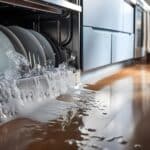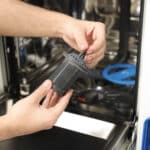
The most common cause of a dishwasher that won’t drain is a clogged lower filter, not a failed pump. Before assuming you need a replacement part, work through the checks below in order. They’re ranked from most to least likely based on how these cases typically resolve.
This page is one piece of our full dishwasher troubleshooting guide. Worked through every check below and still got standing water? Move on to our no-blockage follow-up guide, which zeroes in on the pump itself.
Quick Diagnosis Table
| Cause | Likelihood | Difficulty | Typical Part Cost |
|---|---|---|---|
| Clogged lower filter | Very likely | Easy (no tools) | $0 — cleaning only |
| Kinked or clogged drain hose | Likely | Easy | $10–20 if replaced |
| Disposal knockout plug not removed | Likely on new installs | Easy | $0 |
| Clogged air gap | Possible | Easy | $0–15 |
| Failed check valve | Possible | Moderate | $10–25 |
| Worn-out drain pump | Rare | Moderate | $25–75 |
| Faulty control board | Rare | Professional recommended | $80–200+ |
Repair or Replace?
Every cause on this page except a failed control board costs well under $75 in parts and an hour or less of your time, so repairing is the clear choice. A control board runs $80–$200 in parts plus labor if you hire it out; on a unit older than 8–10 years, that’s usually the point where a new dishwasher makes more sense than a third repair.
Whirlpool, GE, Samsung, LG, Bosch, KitchenAid, Frigidaire, and Maytag all place the filter and pump slightly differently, and reset procedures vary by model. See the brand-specific guide for your model: Whirlpool, GE, Bosch, Samsung, LG, KitchenAid, Frigidaire, or Maytag.
Frequently Asked Questions
Why is there a little water left at the bottom even when it's draining fine?
A shallow film of water around the drain area is normal on most models and keeps the pump seal from drying out. Water covering the whole tub bottom is not normal.
Can I run a cycle to try to clear a dishwasher that won't drain?
Not until you've cleared the clog — running a cycle on standing water just adds more water on top of the blockage and risks tripping the overflow float switch.
I just installed a new dishwasher and it won't drain at all — what should I check first?
Check whether the garbage disposal's knockout plug was removed before the drain hose was connected. It's the single most common new-install mistake and blocks drainage completely.
How can I check the drain pump without a multimeter?
You can't confirm a failed motor without one, but you can rule out a jam by checking whether the pump's impeller — visible once the filter is removed — spins freely by hand.
Is a clicking sound during the drain cycle normal?
A brief hum is normal. A clicking or grinding sound usually means something rigid, like glass or a bottle cap, is caught in the pump or chopper blade.
Consider this a starting point for troubleshooting, not professional repair advice. When in doubt, a licensed technician should make the final call.