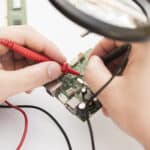
On most Whirlpool electric dryers, the thermal fuse is mounted on the blower housing or exhaust duct at the back of the cabinet, right where a clogged vent does the most damage by trapping heat. It’s a five-minute test with a multimeter and, along with the vent itself, the first thing worth checking.
We’re assuming you’ve already worked through our full Dryer Not Heating guide and its diagnostic order, what follows zeroes in on Whirlpool’s specific part locations, reset steps, and error codes. You’ll find it filed under our broader dryer troubleshooting hub.
Whirlpool Reset Procedure
Unplug the dryer for 1 minute to power-cycle the control board, or on models with electronic controls, hold Start for 3 seconds after pressing Pause/Cancel twice. A reset won’t fix a blown thermal fuse or a failed heating element, both of which are hardware faults, but it does clear a stuck control fault that can look identical to a heating problem from the outside.
Where the Thermal Fuse and Heating Element Are
On most Whirlpool and Maytag-platform electric dryers (Whirlpool builds many Maytag models on the same chassis), the thermal fuse is mounted directly on the blower housing at the back, and the heating element sits inside a housing accessible from the back panel. Gas models have a burner assembly in roughly the same location instead of an element; the igniter and gas valve on those should be left to a licensed technician.
Error Codes You Might See
Newer electronic Whirlpool dryers may display “AF” or a flashing airflow indicator when the moisture sensor detects poor airflow, which is a direct pointer to a clogged vent. Older mechanical-timer Whirlpool dryers have no error display at all: a no-heat fault just shows up as a cool cycle with no other warning. Always check your specific model’s use and care guide, since code meanings vary by generation.
Where Whirlpool Repairs Get Tricky
The thermal fuse’s location right on the blower housing means it takes the full brunt of any airflow restriction, so on Whirlpool dryers a blown fuse is even more likely to trace back to a dirty vent than on some other brands. It’s a genuinely easy DIY replacement once you’re inside the back panel, with no special tools beyond a nut driver.
Frequently Asked Questions
Where exactly is the thermal fuse on a Whirlpool dryer?
On most models it's mounted directly on the blower housing, accessible by removing the back panel; exact position varies slightly by model year, so check your use and care guide if you don't see it right away.
Does a Whirlpool dryer show a code when the thermal fuse blows?
Most models don't show a specific code for a blown thermal fuse; the dryer simply runs without heat. Some newer electronic models display AF for an airflow restriction, which is often the underlying cause.
Can I test the heating element without removing it?
Yes, with the dryer unplugged you can usually access the element's terminals from the back panel and test for continuity with a multimeter without fully removing the housing.
Consider this a diagnostic starting point rather than a substitute for a qualified technician’s hands-on inspection.