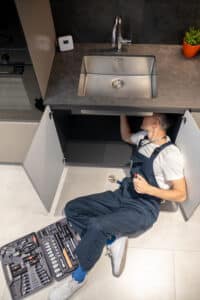
Most garbage disposal problems trace back to one of a handful of usual suspects: a tripped reset button, a jammed flywheel, or trapped debris under the splash guard. Unlike most kitchen appliances, a disposal is a simple, sealed induction motor with almost no electronics to fail, which is exactly why so many “broken” units are actually a five-minute reset or jam-clear away from working again. This guide sorts common failures by symptom, so you can jump straight to the section that matches what your unit is actually doing.
Every symptom page below ranks causes by how often they turn out to be the real problem, includes at least one test you can run before buying any parts, and tells you plainly when a fix is a five-minute job versus when it’s time to call a plumber. One thing every page repeats on purpose: never put your hand inside a garbage disposal, plugged in or not. The flywheel has sharp impeller lugs, and manual jam-clearing is always done from the bottom access hole with a wrench, or from the top with tongs, never by hand.
Garbage Disposal Not Working
A disposal that’s completely dead, no hum, no light, nothing, is almost always a tripped reset button or a tripped GFCI outlet, not a failed motor. See Garbage Disposal Not Working: Causes Ranked by Likelihood for the full diagnostic order before assuming you need a new unit.
Garbage Disposal Humming But Not Working
A hum with no grinding almost always means the motor is running but the flywheel is physically jammed, not that the motor has failed. See Garbage Disposal Humming: Causes Ranked by Likelihood for how to tell a jam from a seized bearing.
Garbage Disposal Jammed
Most jams clear in under five minutes with a hex wrench and the bottom reset button, no disassembly required. See Garbage Disposal Jammed: How to Clear It Safely for the exact procedure and the tools most people already own.
Garbage Disposal Leaking
Where the water appears (at the sink flange, the dishwasher connection, or the bottom of the unit) tells you almost everything before you open a cabinet. See Garbage Disposal Leaking: Find the Source Before You Call a Pro. A leak from the bottom of the case itself is the one leak that always means replacement, not repair.
Garbage Disposal Won’t Reset
If the red reset button won’t stay in, or keeps tripping repeatedly, that’s the unit telling you about an overload or short, not a faulty button. Details: Garbage Disposal Reset: What the Button Actually Does.
Garbage Disposal Smells
A sour or rotten smell is almost never a mechanical problem. It’s trapped food debris on the underside of the splash guard and the flywheel itself, both places a quick rinse never reaches. See Garbage Disposal Smells: Where the Odor Is Actually Coming From for the cleaning method that actually works.
Brand-Specific Guides
InSinkErator and Badger (InSinkErator’s entry-level line) cover the large majority of disposals installed in US kitchens, and both share the same basic reset and jam-clearing procedure with a few model-specific differences. See our InSinkErator troubleshooting guide and Badger troubleshooting guide for exact reset button locations, wrench sizes, and known model quirks.
Repair or Replace?
As a rule of thumb, if your disposal is under 8 years old and the problem is a jam, a tripped reset, a worn splash guard, or a leaking connection, repairing costs little more than a wrench and some time. A new mid-range disposal runs roughly $100–$250 installed as of 2026, so once a unit needs a new motor or the case itself is cracked or leaking from the bottom, replacement almost always wins on cost. Most disposals are also rated for 8–15 years of typical use, so age alone is a reasonable tiebreaker on a borderline call. For the full cost breakdown, see our garbage disposal repair cost guide.
When to Call a Professional
Call a licensed plumber or electrician if the reset button trips repeatedly right after you release it, if you smell burning or see scorch marks near the unit, if the leak is coming from the case itself rather than a connection point, or if the disposal is hardwired (no plug) and the problem seems electrical rather than mechanical. None of the diagnostics on this site substitute for a professional opinion when something feels genuinely wrong.
Frequently Asked Questions
The information provided here is a diagnostic aid and does not replace the intervention of a qualified professional.