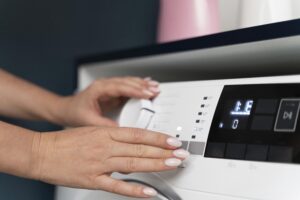
F9 E1 appears when the washer’s drain cycle runs longer than eight minutes. Whirlpool’s own troubleshooting points first to a restricted drain hose or standpipe, or to excess suds slowing the pump, rather than a broken part. On older Duet-platform washers, the same long-drain condition was labeled F21 instead of F9 E1.
Standpipe height is easy to overlook if the washer was recently moved to a new laundry room or a rental unit, since it’s a plumbing detail rather than anything on the washer itself. A pump that sounds like it’s straining, a higher-pitched whine during drain, alongside F9 E1 is a stronger sign the pump or its filter needs a physical look rather than just a hose check.
Is F9 E1 the same as a washer that won't drain at all?
Not quite. F9 E1 specifically means draining is slow, past the 8-minute threshold, while a washer that never drains at all usually points more directly to a blocked pump or filter.
Can too much detergent cause F9 E1 even in a well-maintained washer?
Yes, excess suds create backpressure that slows the pump regardless of how clean the rest of the drain system is, which is why detergent type and amount get checked early.
Does the standpipe height really matter that much?
Yes, Whirlpool specifies a range for a reason: too low or too high changes the siphon effect the drain relies on, and can slow draining even with a completely clear hose.
What's the difference between F9 E1 and F21 on my washer?
They're the same long-drain fault; F21 was used on older Duet-platform control boards before Whirlpool standardized on the F9 E1 label.
The information provided here is a diagnostic aid and does not replace the intervention of a qualified professional.