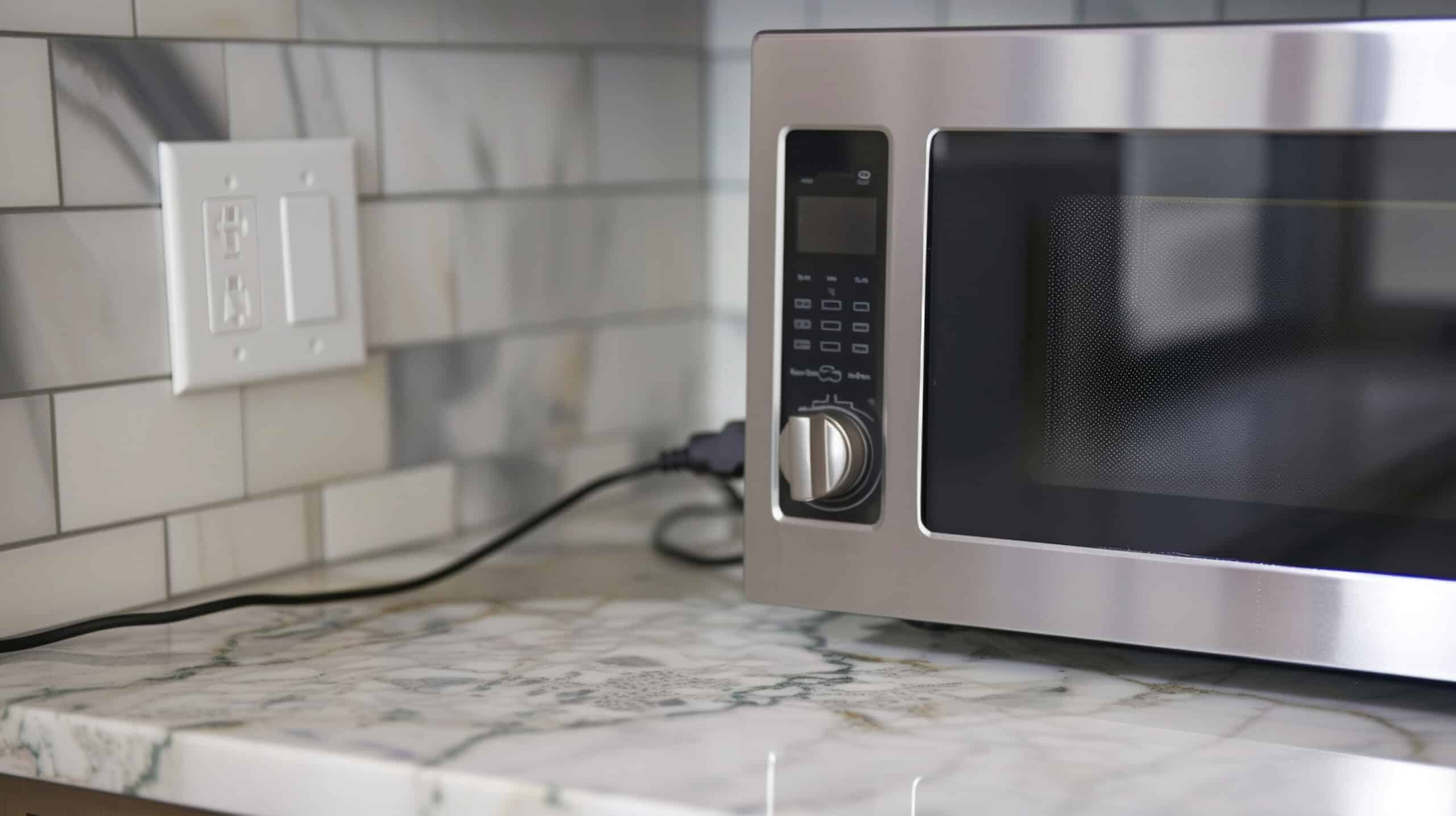
A microwave with no display, no light, and no response to any button almost always traces back to power not reaching the unit at all, not a failed internal part. Confirm the outlet works before suspecting the power cord, an internal fuse, the door switch, or the control board, in roughly that order.
This sits within our broader microwave troubleshooting guide, alongside every other common fault.
Quick Diagnosis Table
| Cause | Likelihood | Difficulty | Typical Part Cost |
|---|---|---|---|
| Dead outlet, tripped breaker, or tripped GFCI | Very likely | Easy (no tools) | $0 |
| Damaged power cord or loose plug | Possible | Easy to check | $10–20 |
| Blown ceramic or thermal fuse | Likely | Professional recommended | $10–20 |
| Faulty door switch blocking startup | Possible | Moderate | $10–25 |
| Failed control board | Rare | Professional required | $60–150 |
Repair or Replace?
Most no-power cases turn out to be the outlet, the cord, or the door switch, all cheap and quick to resolve. An internal fuse is still an inexpensive part, but replacing it means opening the cabinet near the high-voltage capacitor, so it’s worth having a technician handle that specific step even though the part itself is cheap. A control board failure is the one cause here that can make replacement the more sensible option, especially on a microwave that’s already several years old, since the part and labor together often approach the cost of a new unit.
Frequently Asked Questions
I plugged a lamp into the same outlet and it turned on. What does that tell me?
It tells you the outlet and breaker are fine, which rules out the most common cause and shifts suspicion to the microwave's own power cord, internal fuse, door switch, or control board.
What's the difference between a tripped breaker and a tripped GFCI outlet?
A breaker trips at the electrical panel and is reset there; a GFCI outlet trips at the outlet itself and has its own reset button, usually visible on the outlet face, and either one can cut power to the microwave without any internal fault at all.
Can I test the internal fuse myself?
You can visually inspect it once the cabinet is open, but that requires removing the outer casing near the high-voltage capacitor, so the actual test and replacement are best left to a licensed technician even though the part itself is inexpensive.
Why would the door switch stop my microwave from turning on at all?
On some models, the control board won't power up the display or accept input unless the door switches confirm the door is fully closed, so a faulty switch can look exactly like a total power failure.
Is a control board replacement worth it on an older microwave?
Often not. Parts alone run $60 to $150, and once labor is added, that total can get close to the price of a comparable new microwave, especially on a unit that's already several years old.
Should I try a different outlet before assuming the microwave is broken?
Yes. It takes a minute and immediately tells you whether the problem is the microwave itself or the electrical supply to it.
This is meant to help narrow down the cause, not replace a visit from a qualified professional.